Engineering case study / AI-assisted pull request review workflow
ReviewPilot AI
A personal Next.js application and GitHub App exploring structured pull request review. The public demo uses a deterministic mock provider; real LLM analysis requires the optional OpenAI-compatible integration.
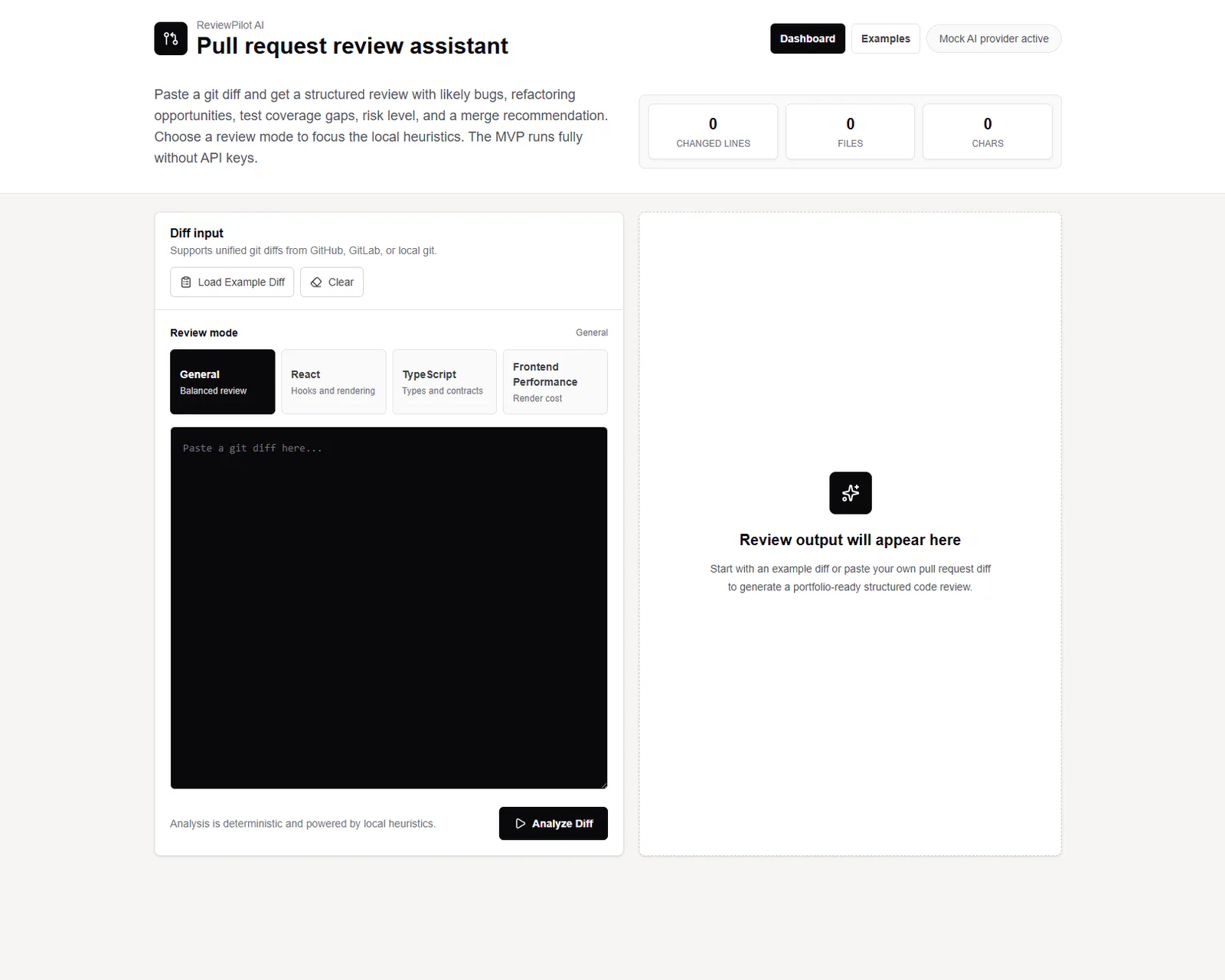
Context
Code review tools often produce unstructured commentary that is difficult to scan, verify or compare. This project explores a more explicit contract between a diff, an analysis provider and the review interface.
Problem
Turn a noisy unified diff into findings that remain tied to files and lines, while keeping provider behavior replaceable and outputs safe to render.
Constraints
- Webhook payloads and signatures must be verified before processing.
- AI-shaped output cannot be trusted without runtime validation.
- The public demo must remain useful without requiring paid model credentials.
My contribution
Product design, frontend architecture, GitHub integration and evaluation workflow.
System boundaries
Architecture
Verified webhook and pull request context
→Parsing, normalization and context budgeting
→Deterministic mock or optional OpenAI-compatible provider
→Validated findings, risk and merge recommendation
Important technical decisions
- Zod validates provider output at the application boundary.
- A provider abstraction separates workflow logic from model-specific transport.
- Line-aware findings preserve a traceable relationship to the source diff.
- The deterministic provider is an explainable fixture—not a real language model—and supports repeatable demos and tests.
Testing and quality
- Vitest covers parsing and workflow behavior.
- Golden cases evaluate whether structured outputs remain stable across representative diffs.
- CI runs automated checks on changes.
Results
- Structured findings with confidence, severity and source locations
- File-level risk, test suggestions and a merge recommendation
- A deterministic demo path plus an optional OpenAI-compatible integration
Trade-offs and limitations
- Structured output improves consistency but constrains free-form provider responses.
- The deterministic provider demonstrates the workflow, not production model quality.
- Automated feedback remains advisory and requires human review.
Alternatives considered
- A model-specific implementation was rejected because it would couple product logic to one provider.
- Free-form Markdown was considered but offers weaker validation and UI guarantees.
Current status
Working public demo; continued experimentation with evaluation cases and provider behavior.